
How to Get the Best Keywords for SEO: A Step-by-Step Guide
Written by Kirsty Wright, founder of Co Thought Digital
Published 7th February, 2026
Whether you’re building a new website, writing blog content or improving your existing pages, choosing the right keywords is one of the most important parts of any SEO strategy.
Many businesses make the same mistake, they target keywords with the highest search volume and wonder why they’re not generating enquiries. The reality is that successful SEO isn’t about attracting the most visitors; it’s about attracting the right visitors.
That’s where keyword research comes in.
By learning how to get the best keywords for SEO, you’ll understand exactly what your audience is searching for, what questions they need answered, and which keywords are worth targeting to grow your website organically.
In this guide, we’ll walk you through our step-by-step keyword research process, explain how to choose keywords that match user intent, and show you how to build topical authority that both Google and AI search tools trust.
What Are SEO Keywords?
SEO keywords are the words and phrases people type into search engines when they’re looking for information, products or services.
For example, someone looking for a local web designer might search for:
- ● web design Bristol
- ● affordable website designer
- ● WordPress web designer
- ● website design for small business
Each of these represents a different keyword with a different level of competition and search intent.
The goal of keyword research isn’t simply finding popular searches. It’s identifying keywords that:
- ● Match what your audience is searching for
- ● Have realistic competition
- ● Fit your business goals
- ● Can generate enquiries or sales
- ● Help build your website’s authority
Think of keywords as the bridge between your customers’ questions and your content.
Why Keyword Research Matters
Without keyword research, you’re creating content based on what you think people want.
With keyword research, you’re creating content based on what people are already searching for.
That difference can dramatically improve your SEO results.
Good keyword research helps you:
● Increase organic traffic
● Attract qualified visitors
● Improve Google rankings
● Discover new content ideas
● Build topical authority
● Understand customer intent
● Stay ahead of competitors
It also prevents one of the biggest SEO mistakes: spending hours writing content nobody is searching for.
Understanding Search Intent Before Choosing Keywords
One of the biggest ranking factors today isn’t the keyword itself – it’s search intent.
Google wants to show pages that best satisfy what the searcher is trying to achieve.
Before choosing any keyword, ask yourself:
Why is someone searching this phrase?
Most searches fall into four categories.
Informational Intent
The user wants to learn something.
Examples include:
● how to get best keywords for SEO
● what is keyword research
● SEO tips for beginners
These are perfect for blog articles and guides.
Navigational Intent
The user already knows where they want to go.
Examples include:
● Google Search Console
● WordPress login
● Co Thought Digital
These searches rarely need targeting unless it’s your own brand.
Commercial Intent
The user is comparing options before making a decision.
Examples include:
● best SEO agency
● SEO software comparison
● best keyword research tool
These visitors are much closer to becoming customers.
Transactional Intent
The user is ready to take action.
Examples include:
● hire SEO consultant
● SEO services Bristol
● website SEO audit
These keywords often have
lower search volume but much higher conversion rates.
Top Tip: Don’t choose keywords based solely on search volume. A keyword with 100 monthly searches that generates five enquiries is often far more valuable than one with 5,000 searches that generates none.
Start 1: Start With Seed Keywords
Every successful keyword strategy starts with a handful of seed keywords.
Seed keywords are broad topics directly related to your business.
If you own a digital marketing agency, your seed keywords might include:
● SEO
● Local SEO
● Website design
● Google Business Profile
● Content marketing
● AI search
● Keyword research
These broad terms act as the starting point for discovering hundreds of related keyword opportunities.
Don’t overthink this stage.
Simply write down every product, service and problem your customers might search for.
A simple exercise is to answer these questions:
● What services do we offer?
● What problems do we solve?
● What questions do customers ask?
● What words would customers use instead of industry jargon?
● What pages already exist on our website?
You should end up with a list of 20–50 broad keyword ideas.
Think Like Your Customer
One of the easiest ways to find great keywords is to stop thinking like a marketer.
Think like your customer instead.
Imagine you’re searching for your own business online.
Would you search for:
“Enterprise digital transformation consultancy”
Or
“Website designer for small business”
Most people search using simple, everyday language.
That’s exactly how your keywords should sound.
If you’re struggling for ideas, download the free guide to find the exact places to uncover keyword ideas.
Step 2: Expand Your Keyword List Using Research Tools
Once you’ve created your list of seed keywords, it’s time to discover the hundreds of related searches your audience is making.
The goal isn’t to collect as many keywords as possible. It’s to uncover the searches that match your customers’ needs and your business goals.
There are plenty of keyword research tools available, but remember: tools provide data, not strategy. A good SEO strategy comes from interpreting that data correctly.
If you’re struggling for ideas, download the free guide to find the exact places to uncover keyword ideas.
Paid Keyword Research Tools
As your SEO strategy grows, investing in a dedicated keyword research tool can save time and uncover deeper insights.
Popular options include:
● Semrush
● Ahrefs
● SE Ranking
● Moz
● Ubersuggest
● Mangools
Most provide similar metrics, including:
● Monthly search volume
● Keyword difficulty
● Search intent
● Related keywords
● Competitor rankings
● SERP features
●Backlink data
Don’t become obsessed with one tool’s numbers. Different platforms estimate search volume differently, so treat the data as guidance rather than absolute fact.
Step 3: Look Beyond Search Volume
One of the biggest mistakes beginners make is choosing keywords purely because they have high search volumes.
More searches don’t automatically mean better SEO opportunities.
Imagine you’re deciding between these keywords:
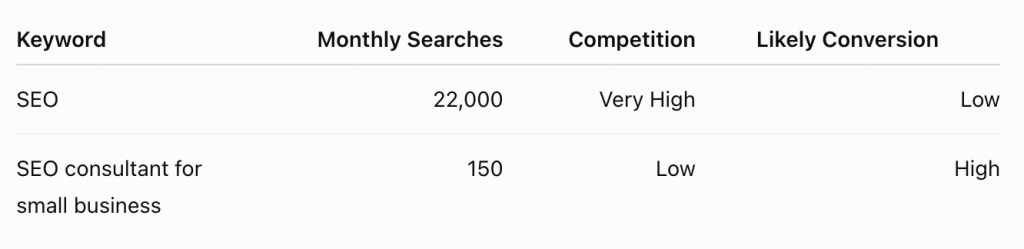
Which would you rather rank for?
The second keyword may attract fewer visitors, but those visitors know exactly what they need and are much closer to becoming customers.
The best keywords balance three factors:
● They are relevant to your business.
● They have achievable competition.
● They attract visitors with genuine buying or enquiry intent.
That’s far more valuable than chasing high-volume vanity keywords.
Step 4: Find Low-Competition Keywords
If your website is new or still building authority, targeting broad competitive keywords is unlikely to deliver quick results.
Instead, focus on long-tail keywords.
Long-tail keywords are longer, more specific search phrases that usually have:
● Lower competition
● Higher conversion rates
● Clearer search intent
● Easier ranking opportunities
For example:
Instead of targeting:
SEO
Target:
● SEO for accountants
● SEO for estate agents
● SEO for charities
● SEO checklist for small businesses
● How to get best keywords for SEO
● Local SEO tips for cafés
Although these keywords have lower search volumes individually, together they can drive significant qualified traffic.
Many successful SEO strategies are built by ranking for dozens of long-tail keywords rather than a handful of highly competitive terms.
Step 5: Analyse Your Competitors
Your competitors have already done some of the hard work for you.
By analysing the keywords they rank for, you can identify opportunities to improve your own content.
Start by searching your main keyword on Google.
Ask yourself:
● Who appears on page one?
● What topics do they cover?
● How detailed are their articles?
● What questions are they answering?
● What information is missing?
The goal isn’t to copy their content. It’s to create something more useful, more comprehensive and more up to date.
A simple way to do this is by identifying content gaps.
For example, you might notice that most keyword research articles explain how to find keywords but don’t show readers how to organise them into a practical content strategy.
That gap becomes your opportunity to add unique value.
Step 6: Prioritise Keywords That Match Your Goals
Not every keyword deserves its own page.
Before you start writing, ask:
● Does this keyword align with my services?
● Will it attract my ideal customer?
● Can I create the best resource on this topic?
● Does it fit naturally within my existing content?
A useful way to prioritise keywords is by considering both business value and ranking potential.
High Priority
● Strong commercial intent
● Relevant to your services
● Realistic competition
● Supports your business goals
Medium Priority
● Good informational content
● Builds authority
● Links naturally to service pages
Low Priority
● High search volume but little relevance
● Difficult to rank for
● Unlikely to generate enquiries
Remember, your goal isn’t simply to increase traffic. It’s to attract visitors who are likely to become customers.
Step 7: Group Your Keywords into Topic Clusters
Finding keywords is only the beginning. The next step is organising them into topic clusters.
A topic cluster is a group of closely related keywords centred around one main subject. Instead of creating separate articles for every variation, you build one comprehensive page that covers the topic in depth and supports it with related content.
For example, your primary keyword might be:
How to get the best keywords for SEO
Supporting keywords could include:
● How to find SEO keywords
● Keyword research for beginners
● Free keyword research tools
● Long-tail keywords
● Search intent
● Keyword difficulty
● Search volume
● Topic clusters
● Keyword mapping
Rather than writing nine short blog posts, create one authoritative guide that answers all of these questions naturally.
This approach helps Google understand that your page comprehensively covers the topic, increasing its chances of ranking for a wide range of related searches.
If a keyword:
● Perfectly matches your audience,
● Answers a genuine question,
● And aligns with your services,
it’s often worth creating content around it, even if your keyword tool reports zero searches.
Some of the highest-converting pages we see target highly specific questions that barely register in keyword tools but consistently attract qualified visitors.
Step 7: Group Your Keywords into Topic Clusters
Google no longer ranks pages based solely on keyword usage. It increasingly rewards websites that demonstrate expertise across an entire subject.
This is known as topical authority.
Instead of publishing dozens of unrelated blog posts, focus on becoming the go-to resource within your niche.
For example, if your business provides SEO services, your content could cover topics such as:
● Keyword research
● On-page SEO
● Technical SEO
● Local SEO
● Link building
● Content marketing
● AI search optimisation
● Google Business Profile
● SEO audits
Each article should link naturally to the others, creating a strong content hub that reinforces your expertise.
Think of your website as a library. A single excellent book is useful, but a well-organised collection on the same subject is far more authoritative.
Step 8: Map Keywords to the Right Pages
One common SEO mistake is trying to rank multiple pages for the same keyword.
This can confuse search engines and make it harder for any of those pages to perform well.
This issue is often referred to as keyword cannibalisation.
Instead, assign one primary keyword to each page and support it with closely related secondary keywords.
For example:
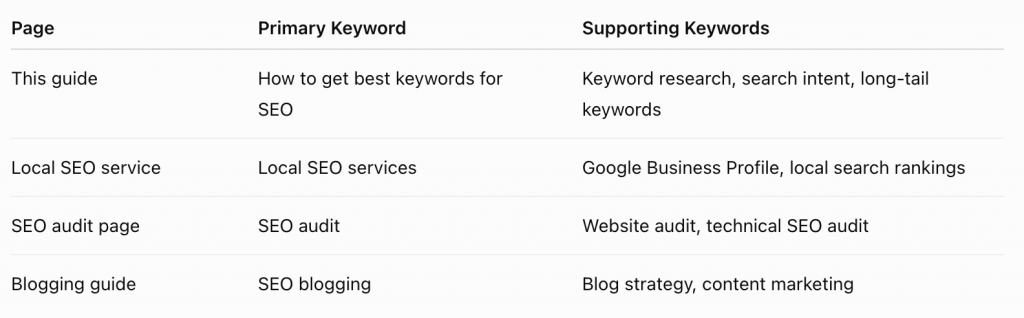
This keeps your content focused and helps search engines understand which page should rank for each topic.
Step 9: Optimise Your Content Naturally
Once you’ve chosen your keywords, it’s time to incorporate them into your content, but naturally.
Keyword stuffing is outdated and can make your writing difficult to read.
Instead, include your primary keyword in key places, such as:
● The page title
● The H1 heading
● The first paragraph
● At least one H2 heading
● The meta description
● The URL (where appropriate)
● Image alt text
● The conclusion
Then use related keywords and natural language throughout the article.
For example, if your primary keyword is how to get best keywords for SEO, it’s perfectly natural to also use phrases like:
● keyword research strategy
● finding SEO keywords
● choosing the right keywords
● search intent
● keyword opportunities
This helps search engines understand the broader topic without making the content repetitive.
How AI Search Is Changing Keyword Research
Search is evolving.
People are no longer searching only with short phrases. They’re asking detailed questions using conversational language through tools like ChatGPT, Google’s AI Overviews and other AI-powered search experiences.
Instead of searching:
“SEO keywords”
Users now ask:
“How do I find the best keywords for my small business website?”
Or:
“What keywords should a local business target for SEO?”
This shift means your content should answer complete questions rather than simply target isolated keywords.
To future-proof your SEO:
● Write naturally and conversationally.
● Answer related questions within the same article.
● Include practical examples.
● Demonstrate real experience.
● Cover the topic comprehensively.
Content that genuinely helps readers is more likely to be referenced by AI search tools and earn visibility beyond traditional search results.
Build Content Around Problems, Not Just Keywords
Many businesses start with a keyword and then write an article.
A more effective approach is to start with your customers’ problems.
For example:
Customer problem:
“My website isn’t getting any traffic.”
Possible content ideas include:
● Why your website isn’t ranking on Google
● How to get the best keywords for SEO
● Common SEO mistakes
● How to improve website visibility
● What is search intent?
Each article addresses a real concern while naturally targeting relevant keywords.
This creates content that is useful, engaging and aligned with the way people search.
Expert Tips for Better Keyword Research
After years of helping businesses improve their online visibility, we’ve found that successful keyword research follows a few simple principles:
Focus on relevance before search volume.
A smaller audience that’s actively looking for your services is often more valuable than a larger audience with no intention of buying.
Think like your customer.
Avoid industry jargon where possible. Use the words and phrases your audience actually uses.
Update your keyword research regularly.
Search behaviour changes over time. Review your keyword strategy every few months to identify new opportunities.
Create the best resource available.
Don’t aim to produce more content than your competitors—aim to produce better content.
Measure what matters.
Track rankings, traffic and enquiries rather than focusing solely on impressions or keyword positions.
Common Keyword Research Mistakes
Avoid these common pitfalls:
● Choosing keywords based only on search volume.
● Ignoring search intent.
● Targeting keywords that are too competitive.
● Creating multiple pages for the same keyword.
● Writing separate articles for every keyword variation.
● Neglecting internal linking.
● Failing to update older content.
● Forgetting to measure performance using Google Search Console and analytics.
Learning from these mistakes can save time and help you build a stronger SEO strategy from the start.
Frequently Asked Questions
SEO keywords are the words and phrases people type into search engines when looking for information, products or services. Choosing the right keywords helps search engines understand your content and connect it with people searching for what you offer.
Start by identifying topics your customers search for, then use tools like Google Search Console, Google Keyword Planner and Google Autocomplete to discover related keywords. Focus on search intent, relevance and realistic competition rather than search volume alone.
There isn’t a single best tool, but Google Search Console, Google Keyword Planner, Google Autocomplete and Google’s People Also Ask section are excellent free resources for discovering keyword opportunities.
Not always. High-volume keywords are often highly competitive. Lower-volume, long-tail keywords with clear buying intent can generate better rankings and more qualified leads.
Long-tail keywords are longer, more specific search phrases, such as “how to get the best keywords for SEO” or “SEO services for small businesses”. They typically have lower competition and higher conversion rates than broad keywords.
Each page should focus on one primary keyword supported by several closely related secondary keywords. This helps search engines understand the page’s topic while allowing it to rank for multiple relevant searches.
Search intent is the reason behind a search query. Someone might be looking for information, comparing options or ready to make a purchase. Matching your content to the user’s intent is one of the most important factors in modern SEO.
Review your keyword strategy every three to six months or whenever you publish new content, launch new services or notice changes in your search rankings. Regular reviews help you identify new opportunities and adapt to changing search behaviour.
Yes. Many websites achieve excellent rankings using free resources like Google Search Console, Google Autocomplete, Related Searches and People Also Ask. Paid tools simply provide more data and can make research more efficient.
A keyword is a specific search phrase, while a topic cluster is a group of related keywords organised around one central topic. Topic clusters help build topical authority and improve your chances of ranking for a wider range of searches.
Keyword difficulty is an estimate of how hard it may be to rank for a particular search term. While useful, it should be considered alongside search intent, business relevance and the quality of competing content.
Keyword research can influence your SEO strategy immediately, but ranking improvements typically take several weeks or months. The timeline depends on factors such as your website’s authority, competition and the quality of your content.
Yes. Keywords remain an important part of SEO, but search engines now place greater emphasis on understanding topics, search intent and the overall context of a page. Rather than focusing on repeating one keyword, create comprehensive content that answers related questions and demonstrates expertise. This approach helps your content perform well in both traditional search results and AI-powered search experiences.
About the Author
Kirsty Wright is an SEO and PPC specialist who helps businesses grow their online visibility through strategic search marketing. With hands-on experience managing SEO and paid advertising campaigns across a variety of industries, she specialises in driving organic traffic, improving search performance, and generating measurable business results. Kirsty regularly researches and tests the latest developments in AI-powered search, including Google AI Overviews, helping businesses understand how search is evolving and how to maximise their visibility in both traditional and AI-generated search results.